Lab 3: Square Waves and RC Time Constants
The purpose of this lab is to measure the step and square wave response of an RC circuit.
1. First, we will learn how to use the oscilloscope to observe and measure rise times and fall times. Set the frequency of your function generator to about 10 Hz and display a square wave and then a triangle wave from your function generator. Note and sketch any difference when the scope input is a.c. or d.c. coupled. Can you explain why the signal is degraded on a.c. coupling? Use d.c. coupling for the rest of this lab.
2. Set the frequency to 1 kHz. Measure the risetime of the square wave (the time it takes to go from 10 % to 90 % of its final value) by expanding the time base.
3. Display the 1 kHz square wave from the `adjust probe' output of your scope. Adjust the trigger to obtain a stable waveform if necessary. Measure the amplitude of the waveform with the probe on the `1X' and `10X' positions.
4. `Compensate' the probe in the 10X position to correctly reproduce the square wave. Plot the wave shape when the probe is under-compensated and over-compensated.
Why does one use a 10X probe? (There are 3 possible reasons.)
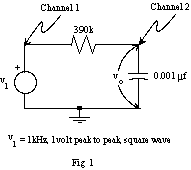
5. Construct the RC circuit shown in Figure 1 on your breadboard. Use your function generator to generate the square wave. Display both the input and output on the scope. Make sure the time base is calibrated. Trigger on the leading edge of the input.
What is the theoretical time constant "tau" of this circuit? What happens as the input period is varied between 10 "tau" and 0.1 "tau"? Explain.
Plot the output waveforms of a single period when for the input periods T = 10 "tau", "tau", and 0.1 "tau". Label your axes.
6. For T = 10 "tau", the initial part of the waveform is the step response of the circuit. Measure the time constant of the response by measuring its 10-90 % risetime. (How does the 10-90 % rise time relate to the time constant "tau"?) Compare with the theoretical time constants.
For which pulse length does the output most resemble the input?
7. Repeat parts 5-6 with the R and C interchanged. Sketch the circuit. Plot the waveforms as the pulse length is varied. Answer the following questions:
Why do the waveforms `undershoot' below 0V\ D.C.?
What is the step response of the circuit?
What is the response to a short pulse? Why does the response `droop'?