Lab 5: Operational Amplifiers - Part II Current-to-Voltage Amplifiers
In last week's lab, we used operational amplifiers to amplify voltages. In this lab we will experiment with various operational amplifier circuits which convert a current to a voltage. We will use optical and temperature sensors which produce an output current proportional to the incident light intensity or temperature. The sensor current is converted to a low impedance output voltage by means of a current-to-voltage amplifier configuration. In both cases the sensors need a bias voltage across them to operate properly.
A. Optical Detector
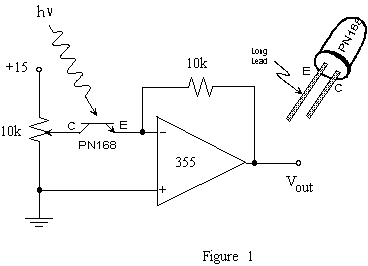
1. Construct the optical detector circuit shown in figure 1 using a 355 FET-input amplifier and the TIL 414 phototransistor. (The 355 more closely approaches an ideal op amp but has the same pin connections as the 741.) Vary the collector voltage VC to determine whether the 414 acts more like a current source controlled by the incident light or variable resistor whos resistance changes with light.
2. Observe and sketch the output waveform, being sure to note where 0 V d.c. is. Confirm that the output is caused by light incident upon the phototransistor. What is the source of the time varying light incident on your detector? (Hint: Measure its frequency.) Test your hypothesis by disabling the offending light source. Is there still a residual light level? What is its source?
3. The spec sheet for the TIL414 says that 20 mW/cm2 incident light intensity produces 7 mA collector current with VC = 5 volts. Use this to estimate the incident light intensity (irradiance). Compare this with the intensity of direct sunlight (I sunlight = 100 watts/m2 ).
B. Temperature Sensor
4. Construct the temperature sensing circuit shown in figure 2 using an Analog Devices Model AD590 Sensor. This is a two-terminal device which behaves as an ideal current source of 1mA/Kelvin over the temperature range -55 to +150 degrees C. Pin connections are as shown.
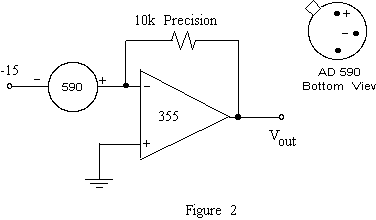
6. a) What is the sensitivity of the above circuit (Volts/Kelvin)?
b) How could the sensitivity be increased?
c) Approximately how much could the sensitivity be increased without saturating the amplifier output?
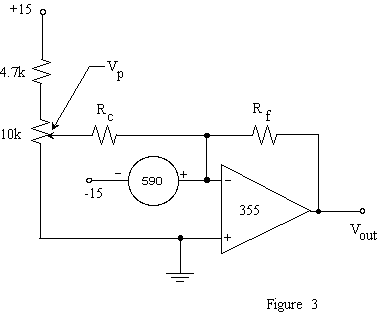
7. Greater sensitivity can be obtained using a summing configuration to cancel out the sensor current at room temperature, as shown in figure 3. (What potentiometer voltage Vp would be needed to do this?) Calculate the feedback resistance Rf required to obtain a sensitivity of 0.5Volts/degree C. Construct the circuit and adjust for 0 V d.c. at room temperature. Is Vp what you expected?