The purpose of this lab
is to investigate voltage regulation techniques for generating
constant voltages and power supplies.
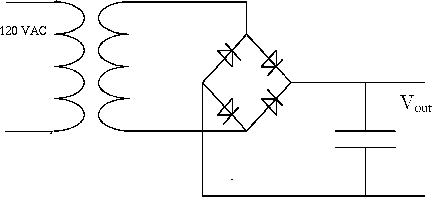
Full-wave Rectifier.
The source of unregulated
voltage in a power supply is usually a half-or full-wave rectified
sine wave from a transformer. For this lab we will use a full-wave
bridge rectifier, as shown below. Construct the rectifier using
1N4007 rectifier diodes and a 100 uF filter capacitor (be
sure to observe the polarity of the capacitor). Do not short
out the transformer secondary.
What output voltage would
be expected if the voltage of the transformer secondary is 10
Vrms? Measure the output voltage with no load resistance and
compare. Use both the oscilloscope and the DMM.
Compute the power that
would be dissipated in a load resistor of 1 kilohm. Apply a 1
kilohm resistor capable of handling the power, and measure the
voltage and peak-to-peak ripple again. (Use your scope in AC
coupling mode to do this.) Compare with theory. What should the
ripple frequency be? What is the observed ripple frequency?
What is the peak inverse
voltage (PIV) across the rectifier diodes? Check that this does
not exceed the PIV rating of the diode. What is the current capability
of the diode? For the rest of the experiment, put the unregulated
voltage on one of your breadboard busses. Remove the load. You
will put the load on the regulated voltage later.
Discrete Component Regulators.
An emitter follower circuit
can be used to buffer the output of a simple zener voltage regulator,
as shown below. We will use a power transistor for the emitter
follower, the TIP31, because of the power demands that we will
place on the circuit. Choose R such that a minimum of 12 mA
of current will flow through the zener diode.
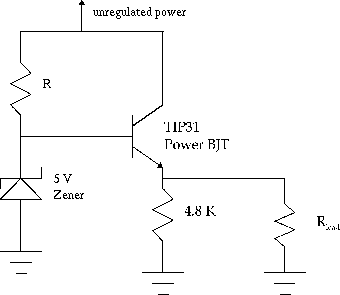
What is the expected output
voltage of the regulator? Construct and test the circuit, using
the unregulated output of your rectifier as the supply voltage
for the circuit, and with Rload = 1 kilohm, as before.
Measure and note the various voltages on your schematic. Then
do the following:
Feedback in Voltage
Regulation
The circuit used above
effectively `compares' the output voltage with the voltage across
the zener diode and maintains about 0.7 V difference between
the two. The following op amp circuit does a better job of comparing
the two voltages. Within limits, the op amp drives the base of
the regulator transistor such that the output voltage is equal
to the zener voltage.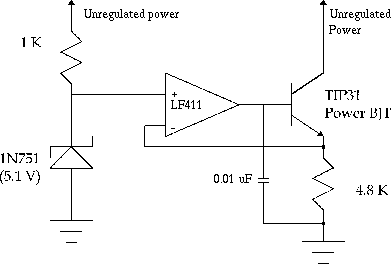
Construct the circuit and
measure the output voltage and ripple. How is this different from
before, and why? Why is this circuit better than before? What
limits the output current of this regulator?
In the above circuit the
output ripple should be the same as the ripple across the zener
diode. The ripple can be practically eliminated if the reference
voltage is derived from an already regulated source (+15 V, say).
In this case the zener diode is not needed and the reference
voltage can be varied using a potentiometer. Implement the variable
reference using a 10-kilohm potentiometer and adjust the output
to be 5.1 volts, as before. What is the p-p output ripple now,
and what is the ripple rejection?
The regulator can be protected
against a short circuit on its output by adding another transistor,
as shown below. If the output current exceeds a certain value,
Q2 is turned on and `robs' Q1 of its base current. Try this circuit.
What would you expect the maximum output current to be? Test
by decreasing the value of Rload (add other resistors
in parallel).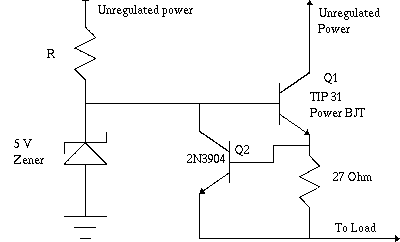
Integrated Circuit Regulators.
The circuit that you have
just tested is the basic technique employed in the LM105 integrated
circuit adjustable voltage regulator. Another IC regulator which
is somewhat easier to use is the LM317. It is a three-terminal
package in which the output is regulated to be 1.25 volts greater
than the `adjust' input, which is a high impedance input. For
this regulator, Vout = 1.25 (1 + R2 / R1).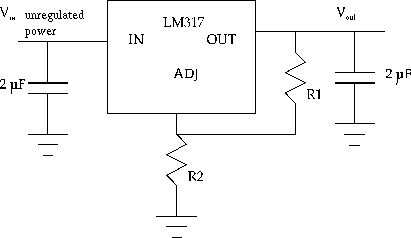
Design a 5 volt regulator
and build and test the circuit, using the unregulated output from
your rectifier as the input to the regulator. Measure the load
regulation and ripple rejection.
Replace R2 with a 10 kilohm
pot and test the 317's operation as an adjustable regulator.
What is the minimum output voltage of the adjustable regulator?